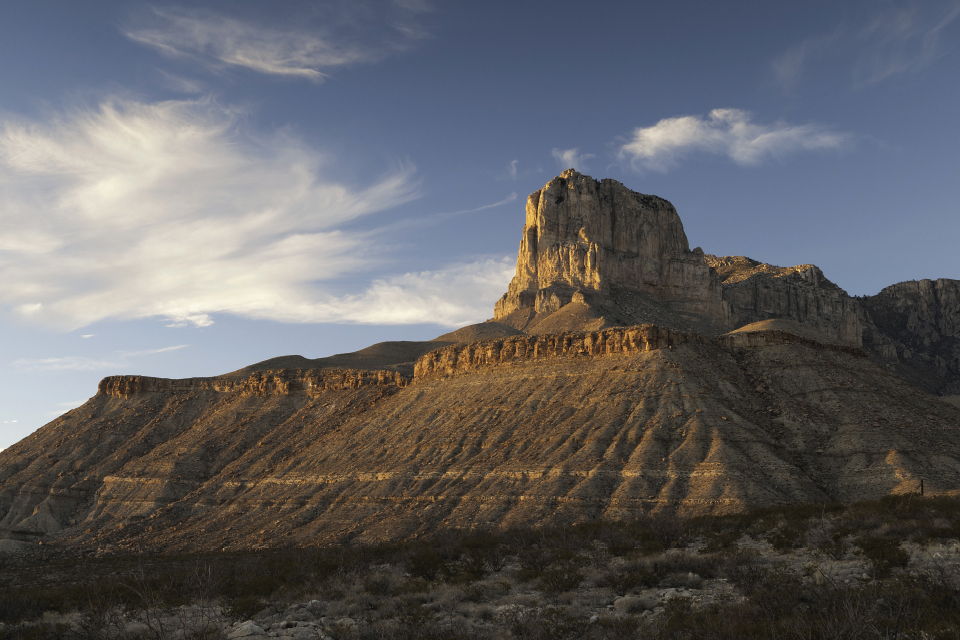
When you’re gazing down from a peak that is so high up you’re leveled with the clouds, there’s a surrounding ethereal beauty that makes even the most strenuous hike well worth the trip. Any fear of heights quickly vanishes, despite standing 8,749 feet above sea level. The vast country of mountains and desert plains boast breathtaking views that are to die for, and yet, make you feel like it’s the closest we’ll get to heaven while feeling so alive.
Somewhere between heaven and Texas, and nestled along the border of New Mexico, Guadalupe Peak is the state’s highest elevation. Actually, Guadalupe Mountains National Park fills the podium, claiming the top three highest points in Texas.
A paradise for hikers, Guadalupe Mountains National Park is one of the few picturesque places in the state that rotates through four definite seasons. The park received 18 inches of snow at Dog Canyon this past winter, and happens to be a popular spring break destination due to the ideal camping weather. Fall is the busy season, courtesy of maple and hardwood trees showing off foliage and dramatic color changes that light up the desert.
A Rich History
Although archaeological evidence suggests GMNP has been occupied by humans for over 10,000 years, the park experience is a celebration of West Texas early settlers. The Smith family were early pioneers to the area, braving the weather conditions and harsh environment, navigating life without a previously established community. They staked their claim in the area by staying in those boundaries the longest and the 1880s Joseph Smith Frijole Ranch still stands as a historic attraction to visitors interested in learning about the early inhabitants.
The Guadalupe Mountains have also been home to native tribes—particularly the Mescalero Apaches—for centuries. The local tribes still have a presence in the area, which is another cause for celebration. In early May, the park assists in the production of an annual mescal roast is hosted by the Apaches who still occupy the area.
The Guadalupes are one of four mountains the Mescalero people hold sacred. According to tradition, the tribe once gathered at the summit of El Capitan to survive a great flood that was said to have submerged the world. At the spring celebration, the agave is baked or roasted, and repurposed into many different dishes to pay homage to the food source that the Mescalero consumed with nearly all of their meals.
Crossing the Border
Prolong your adventure by stopping around the nearby attractions. The Guadalupe Mountains are so far west that New Mexico is an easy access. On the New Mexico side of the border, travelers can check out Roswell and embrace the alien conspiracy that put this small town on the map. Additionally, the Living Desert Zoo in Carlsbad exhibits more than 40 species of animals and hundreds of species of plants native to the Chihuahuan Desert. On the Texas side, take in the scenery in Van Horn or explore the vibrant community of El Paso.
It’s largely a hiking park, and if the mountainous scenery isn’t the only part that grabs your interest, the geology and fossils along the various routes are riddled with ancient organisms that have long been extinct. The Permian Reef System is the same ridge in Carlsbad Caverns (tucked away in New Mexico), and due to geological forces, the ridge rose and exposed a section of it but still spans the gateway between Texas and New Mexico.
Backcountry Excursions
The GMNP is vast and abundant with hiking trails and scenic campgrounds. First-time visitors may struggle to decide on a trail or location within the park to explore. More manageable trails, like the Smith Spring Loop, are only two and a half miles long. But for backpackers who want to stay a while, an optimal experience is available by hiking through Pine Springs, spending the night at that camp, and then crossing through Tejas Trails to Dog Canyon. For an easier trek, Pine Springs to McKittrick is a popular way to go, and showcases older hunting shacks built in the 1930s by West Texas settler Wallace Pratt.
Ten small backcountry campgrounds without amenities are available to those who pick up a free permit at park headquarters located at Dog Canyon or Pine Springs. Water is not always readily available, so it’s recommended backpackers and campers prepare by securing about a gallon for each day. The combination of high peaks and strong sunshine is ruthless, so layers and sunblock are a must. If you prefer an RV weekend campout rather than a primitive camping experience, less rustic spots are available in McKittrick Canyon and Devil’s Hall. Regardless of which option you choose, you’ll be surrounded by wildlife and may even catch a glimpse of javelina, elk, roadrunners, mule deer, or mountain lions.
 Gretchen Goswitz